
Acquisitions
The Ridgewood Historical Society & Museum is grateful to the donors and community members who help grow our collection. Each piece that comes through our doors carries a story — connecting us to the families, events, and everyday life that shaped this region. Below are some of our recent acquisitions.
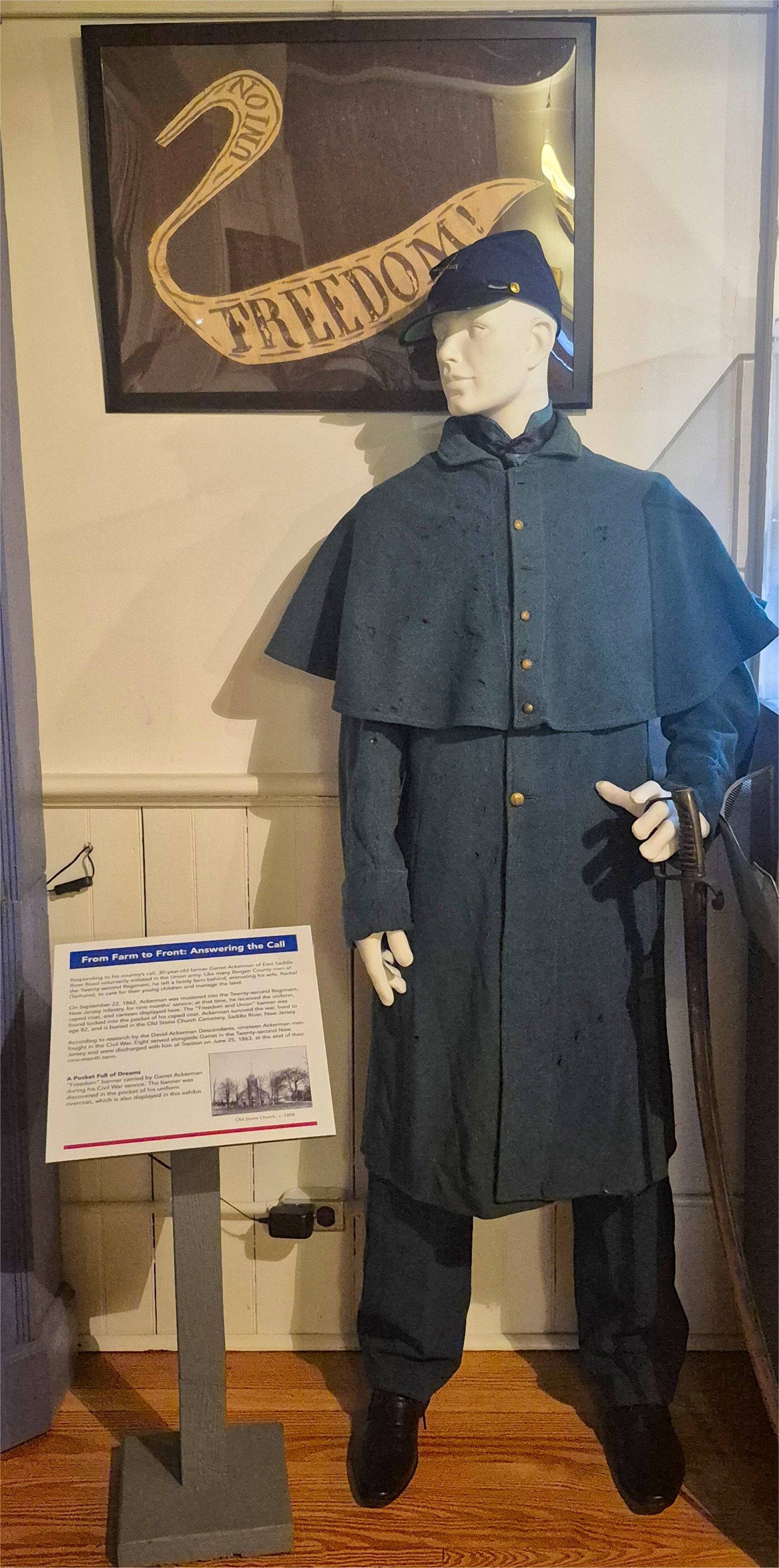
Civil War Uniform
Responding to his country’s call, 30‑year‑old farmer Garret Ackerman of East Saddle River Road voluntarily enlisted in the Union army. Like many Bergen County men of the Twenty‑second Regiment, he left a family farm behind, entrusting his wife, Rachel (Terhune), to care for their young children and manage the land. On September 22, 1862, Ackerman was mustered into the Twenty‑second Regiment, New Jersey Infantry, for nine months’ service; at that time, he received the uniform, caped coat, and canteen displayed here. The “Freedom and Union” banner was found tucked into the pocket of his caped coat. Ackerman survived the war, lived to age 82, and is buried in the Old Stone Church Cemetery, Saddle River.
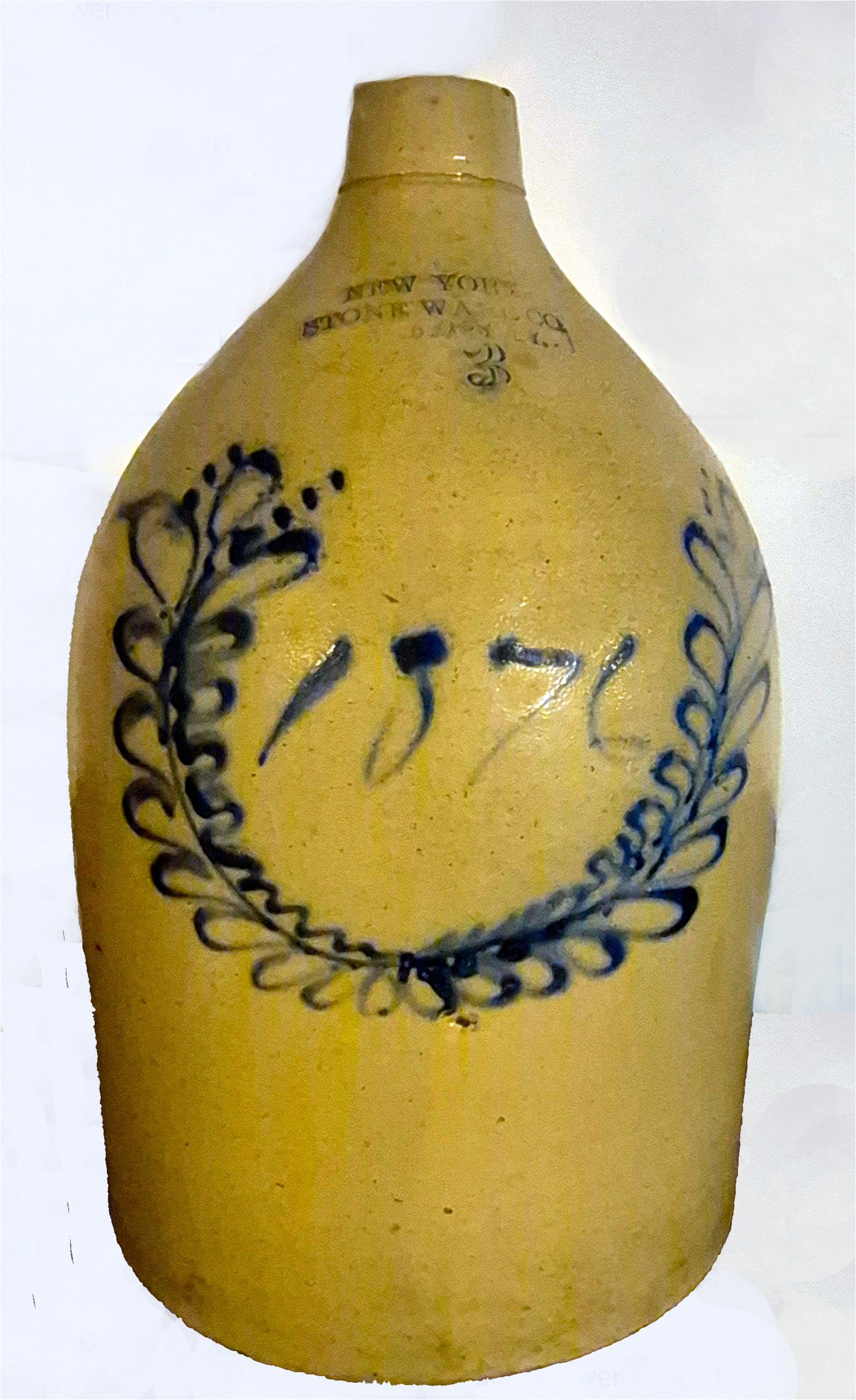
Three-Gallon Centennial Jug, 1876
Extremely rare, three-gallon centennial jug, “1876,” from the New York Stoneware Company, Fort Edward, NY. The jug is decorated in cobalt tinted slip with the “1876” surrounded by a wreath that signifies victory. Theses jugs were used to store and transport liquids from alcohol to molasses.
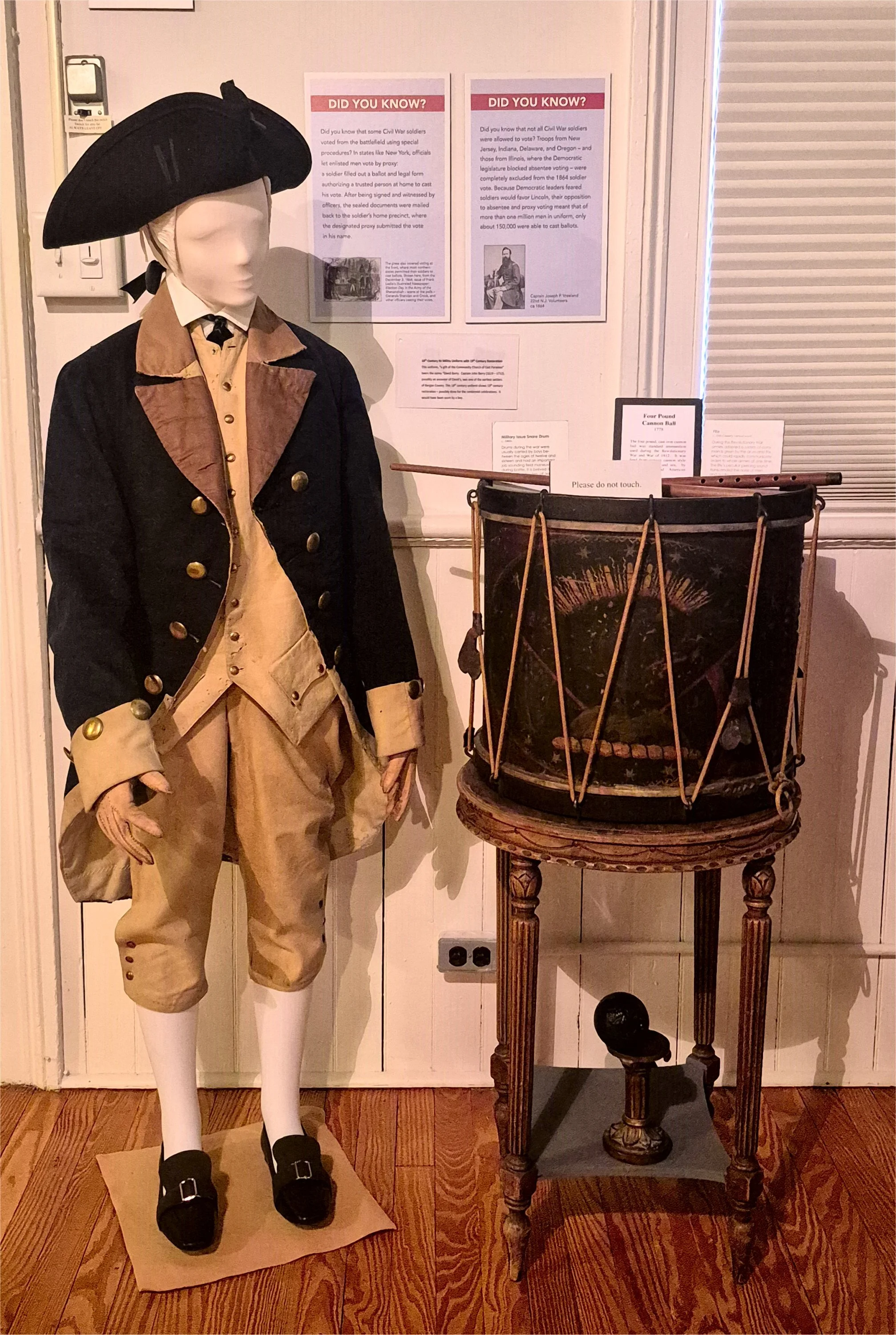
NJ Militia mannequin
18th-century NJ militia uniform with 19th century restoration. This uniform, “a gift of the Community Church in East Paramus” bears the name “David Berry.” Captain John Berry (1619 – 1712), possibly an ancestor of David’s, was one of the earlies settlers of Bergen County. This 18th-century uniform shows 19th-century restoration – possibly done for the centennial celebrations. It would have been worn by a boy.
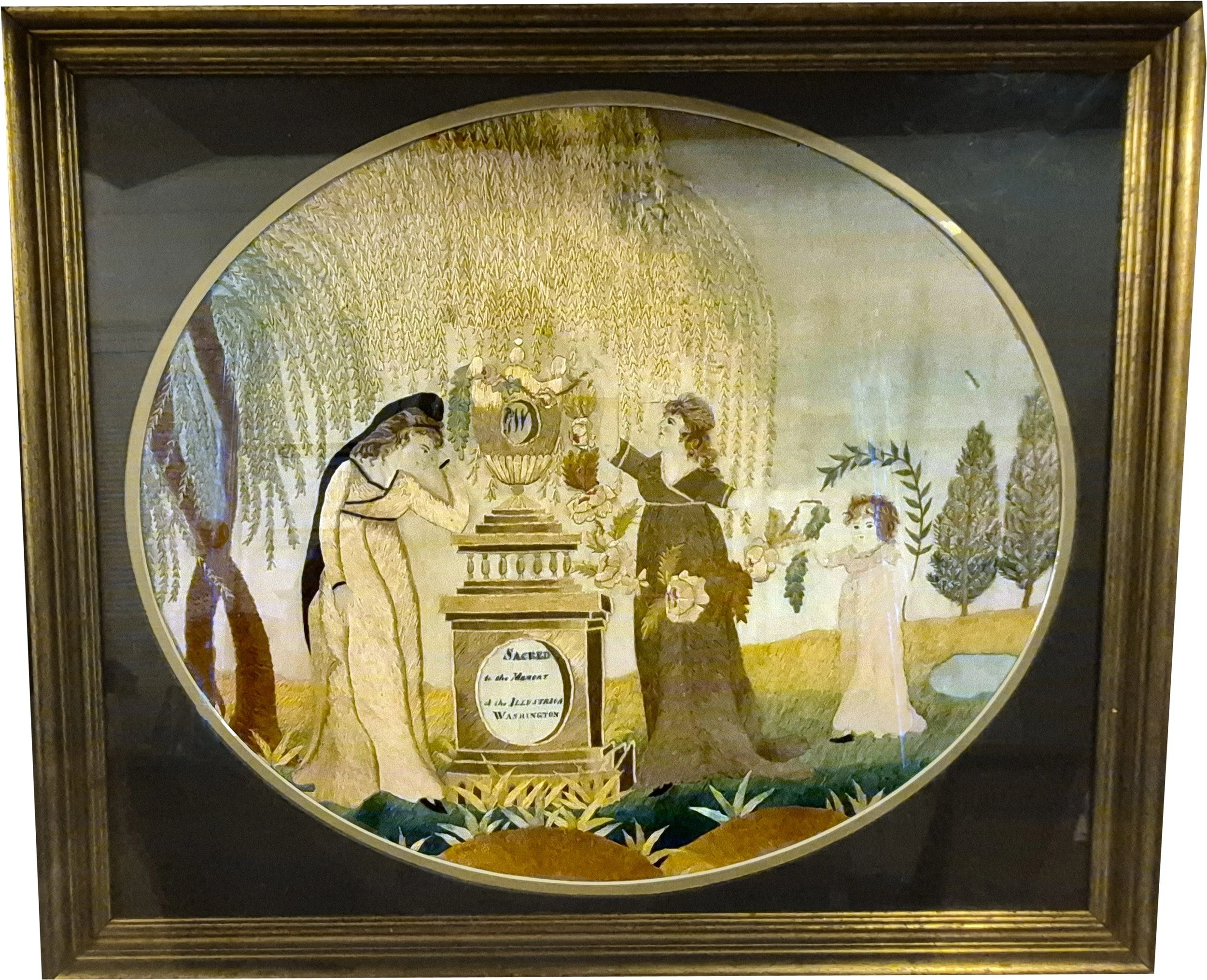
Mourning Sampler, 1807, silk and chenille on silk
This example was likely stitched by a student at the school run by Folwell’s wife, Elizabeth Folwell, and includes painted features—such as the heads and hands—by Samuel himself.
This is one of four known examples in this style. Similar samplers with variations are held by the National Museum of American History, The Metropolitan Museum of Art, the Old Barracks Museum in Trenton, and the Schoolhouse Museum.
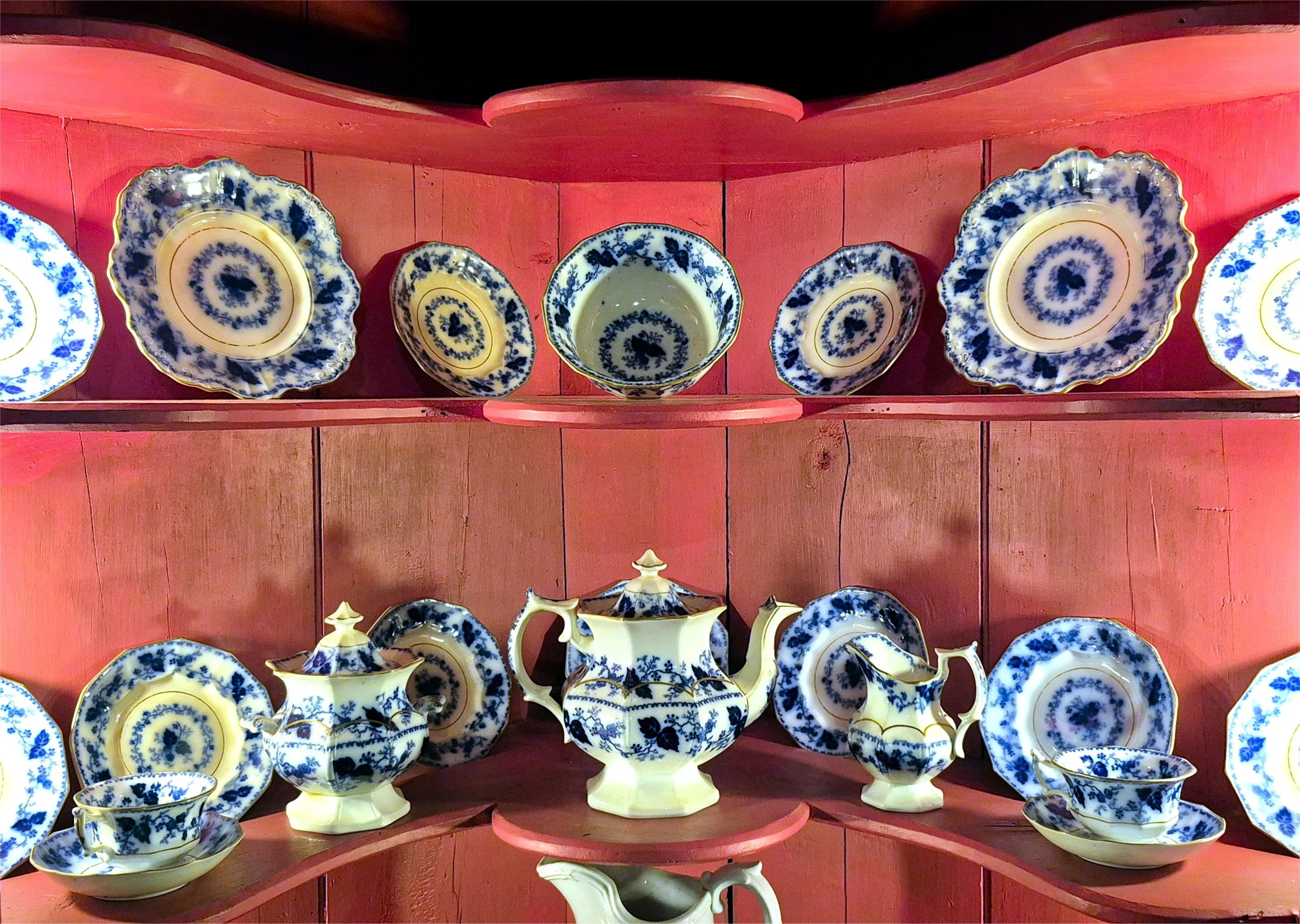
Samuel Chase Tea Set, late 18th century
Originally owned by Samuel Chase, signer of the Declaration of Independence, this fine bone porcelain tea service features a transfer-printed blue floral design with gilt decoration. The set includes a teapot, creamer, sugar bowl, cups, saucers, plates, and a rare slop bowl. Though unmarked, its translucent body, paneled shapes, domed lids, and delicate finials typify late 18th-century English workmanship. The slight diffusion of cobalt in the glaze foreshadows the “flow blue” technique popularized in the 19th century. Each piece is handmade.
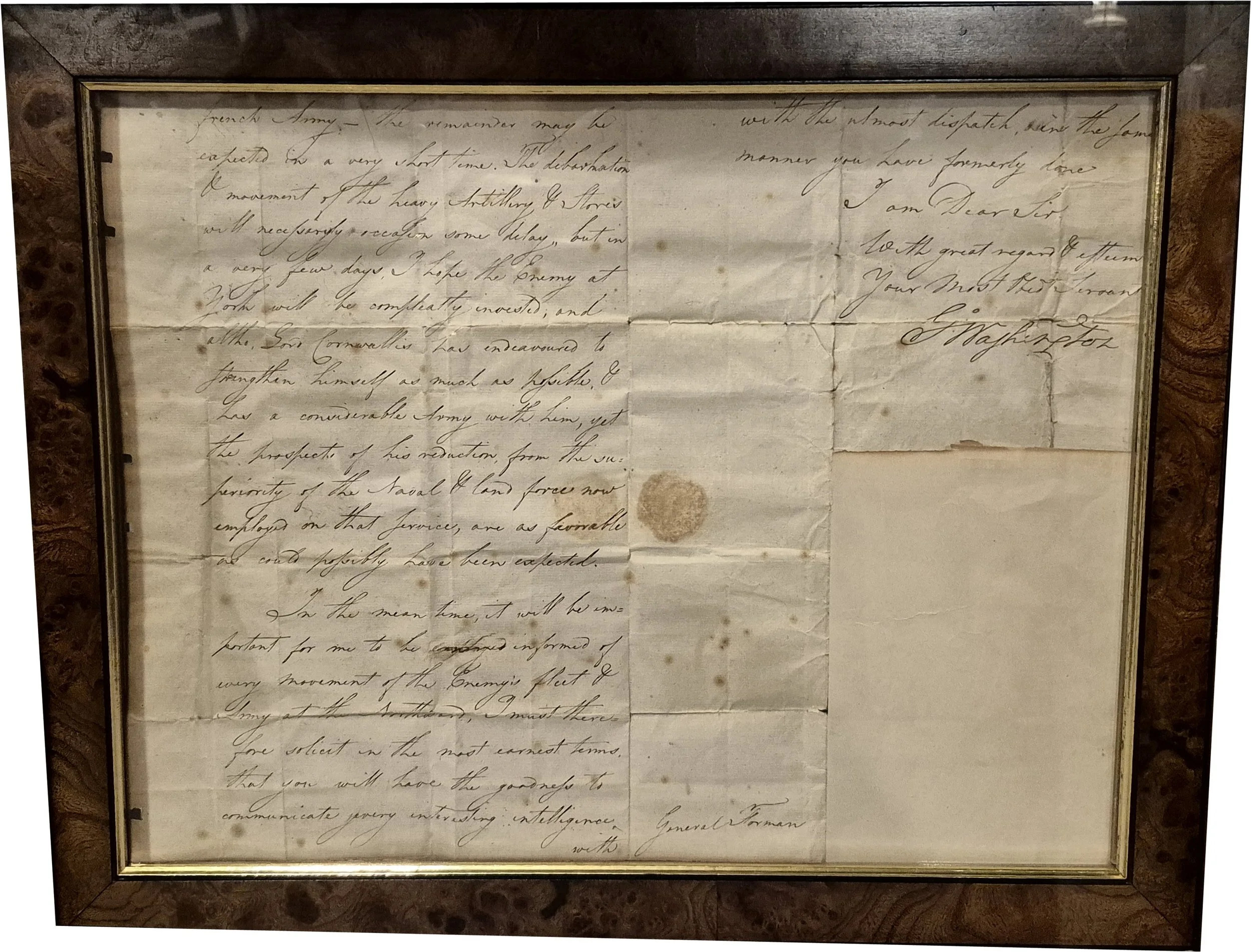
Letter from George Washington to Brigadier General David Forman, September 24, 1781
David “Black David” Forman, a Princeton-educated Monmouth County native, began the Revolution as a lieutenant colonel in a New Jersey state regiment and was promoted to brigadier general of militia in 1777. From coastal outposts, he organized intelligence networks that reported British and French ship movements to General George Washington, who addressed this letter to him. Washington later convened part of Charles Lee’s 1778 court-martial at the original Paramus Church, where Forman testified against Lee.

Scissors & Eyeglasses, 18th century
Betsy Ross (1752–1836) was a Philadelphia upholsterer and flag maker best known for her long association with the early American flag. She wore eyeglasses, eventually went blind, and retired late in life; records also show that she was paid for flags, though the story that she sewed the very first American flag is not supported by primary evidence.
Suspended by ribbon from Betsy Ross’s waist, you’ll notice a pair of 18th-century scissors and a pair of Martin’s Margins, mid-18th-century eyeglasses. These featured objects highlight the practical tools and personal accessories associated with her work. The scissors and eyeglasses help evoke the period and the hands-on nature of her trade as a Philadelphia upholsterer and flag maker.
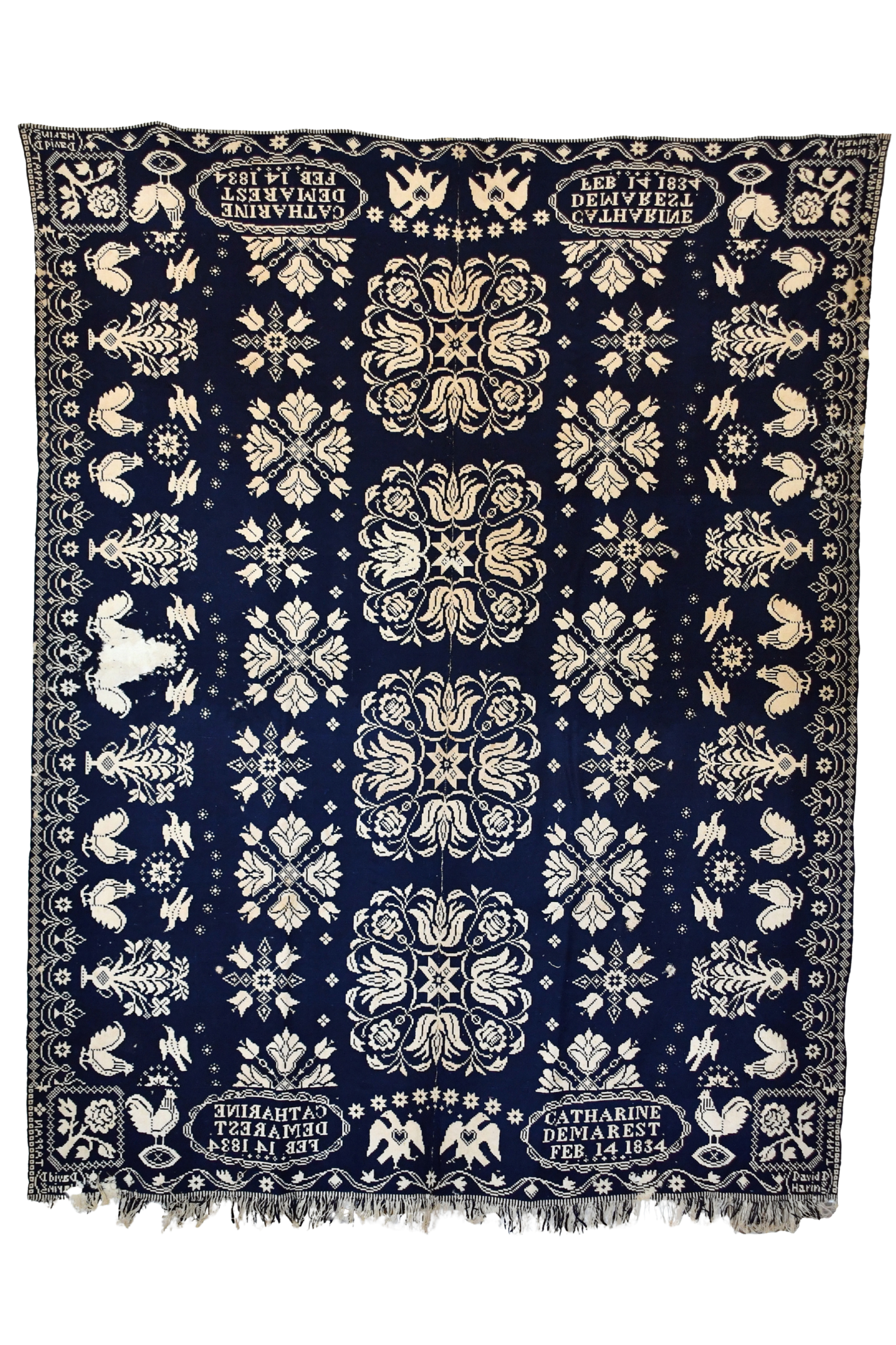
Coverlet, 1834
An anonymous donor has given us a beautiful David Haring blue and white coverlet dated 1834 bears the name Catherine Demarest. She was born in 1810 and married Abraham A. Terhune in 1831. They lived on the Terhune Homestead on East Saddle River Road in the house also known as the Joe Jefferson house and later on a adjacent property.
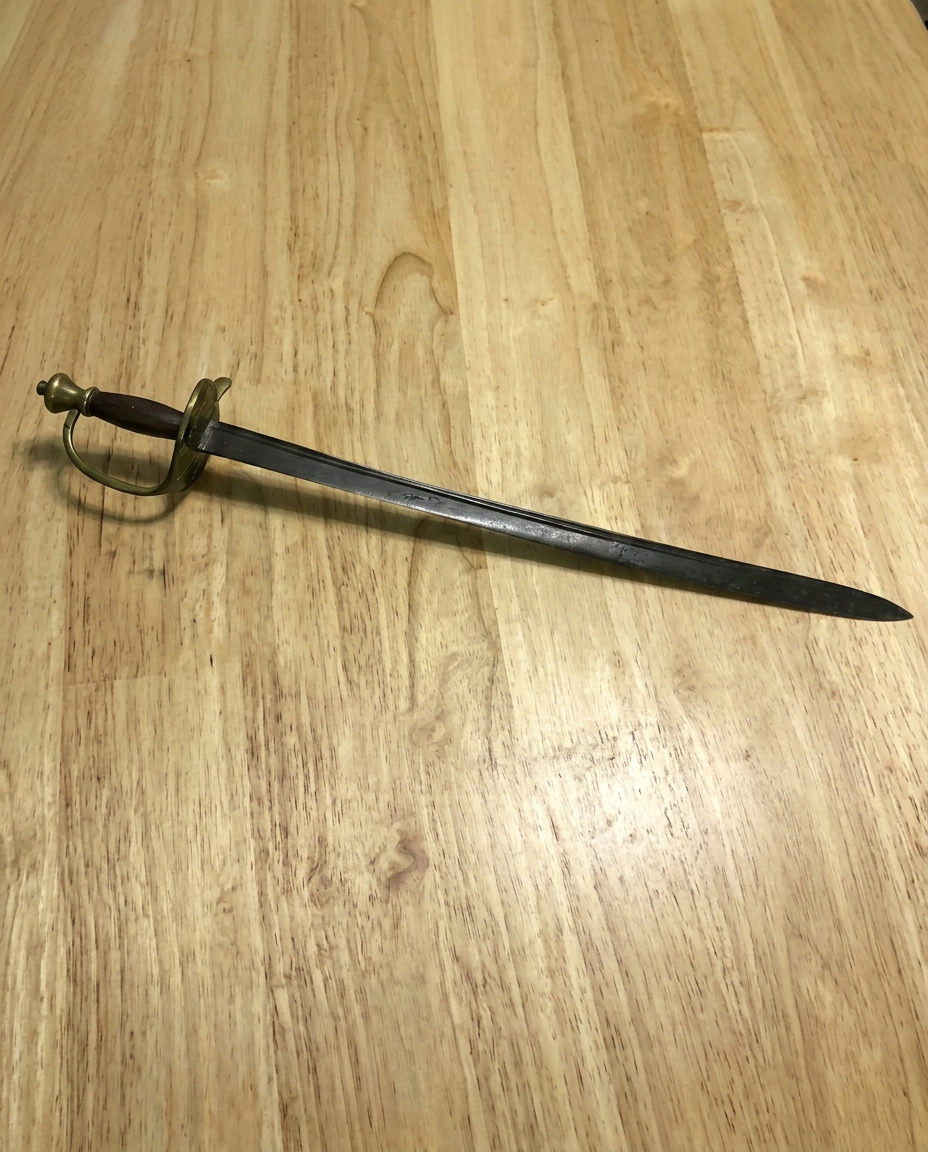
Banta Sword, 18th century
This 18th century sword was found after the American Revolution in the thatch of a barn on a farm belonging to the Banta family in what today is Ho-Ho-Kus. It was kept by the Banta family until 2020 when donated to the historical society. It is an enlisted man’s hangar from pre- French and Indian War period. It is 34” long, and 1747 and the image of a fox are engraved on the blade. From information engraved on the hilt, it would have belonged to a private in the Lieutenant Colonel’s Company, 2nd battalion , First (Royal Regiment of Foot) NO 12 refers to the 12th man on their rolls. At the time, all enlisted men in the British Army carried one of these.
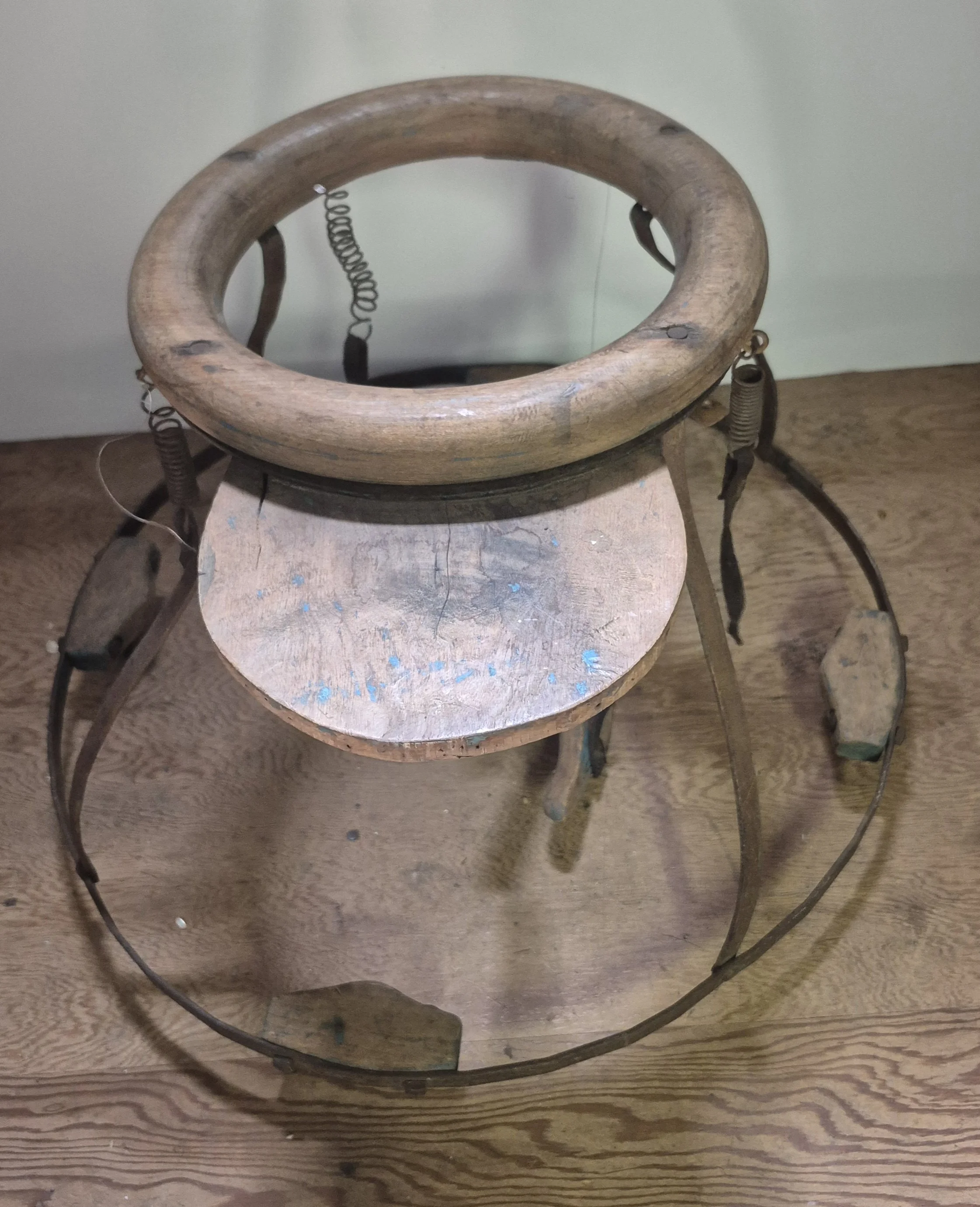
Baby Tender, early 20th century
A wood and metal baby tender from the early 20th century, donated to our collection by Pamela Woods.
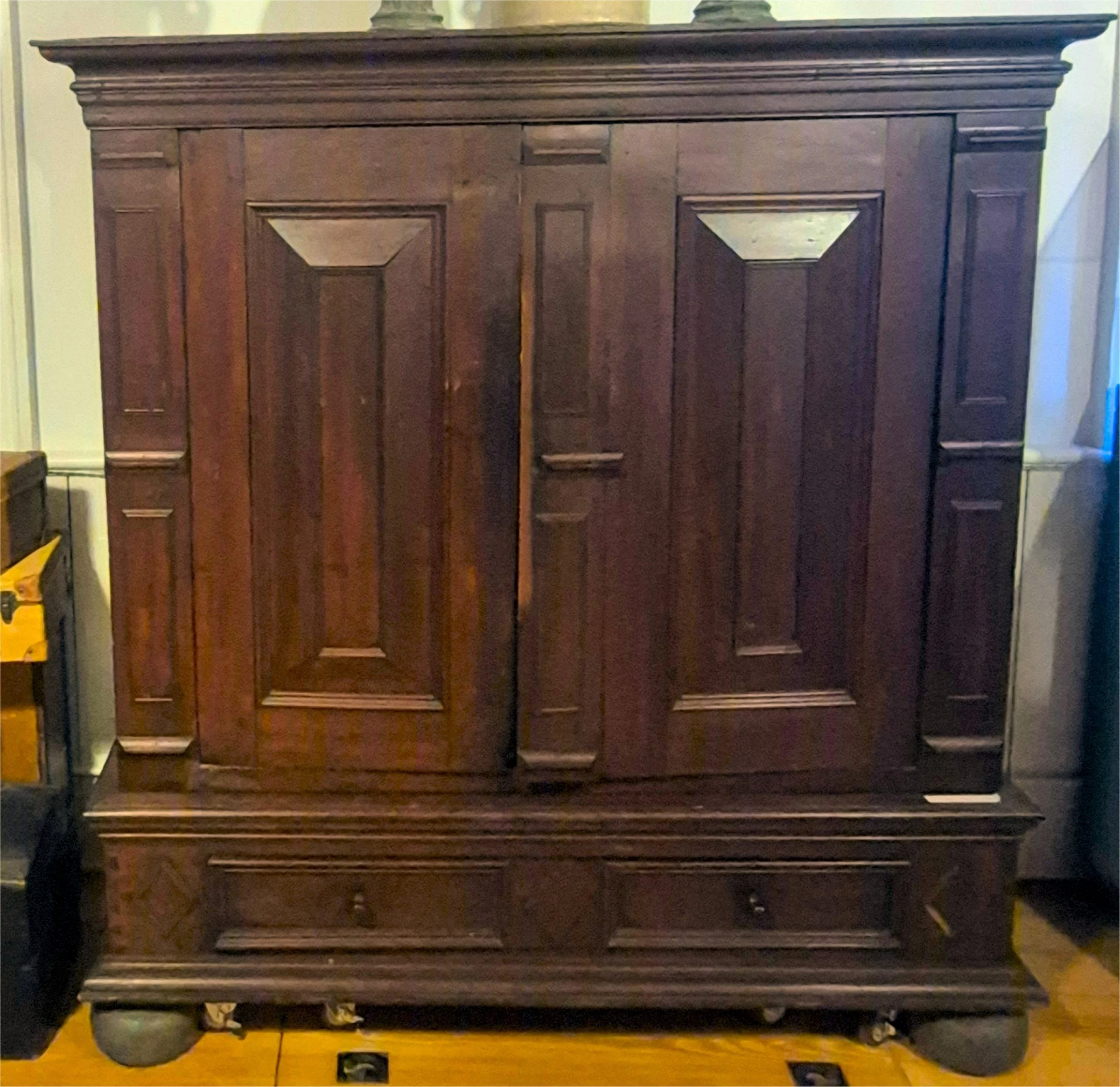
Kas, circa 1700
A kas is a large Dutch-style cupboard for storing household linens, clothing, and valuables, used in the Netherlands and in Dutch colonial America—especially New York and New Jersey—as both practical storage and a conspicuous marker of wealth and status.
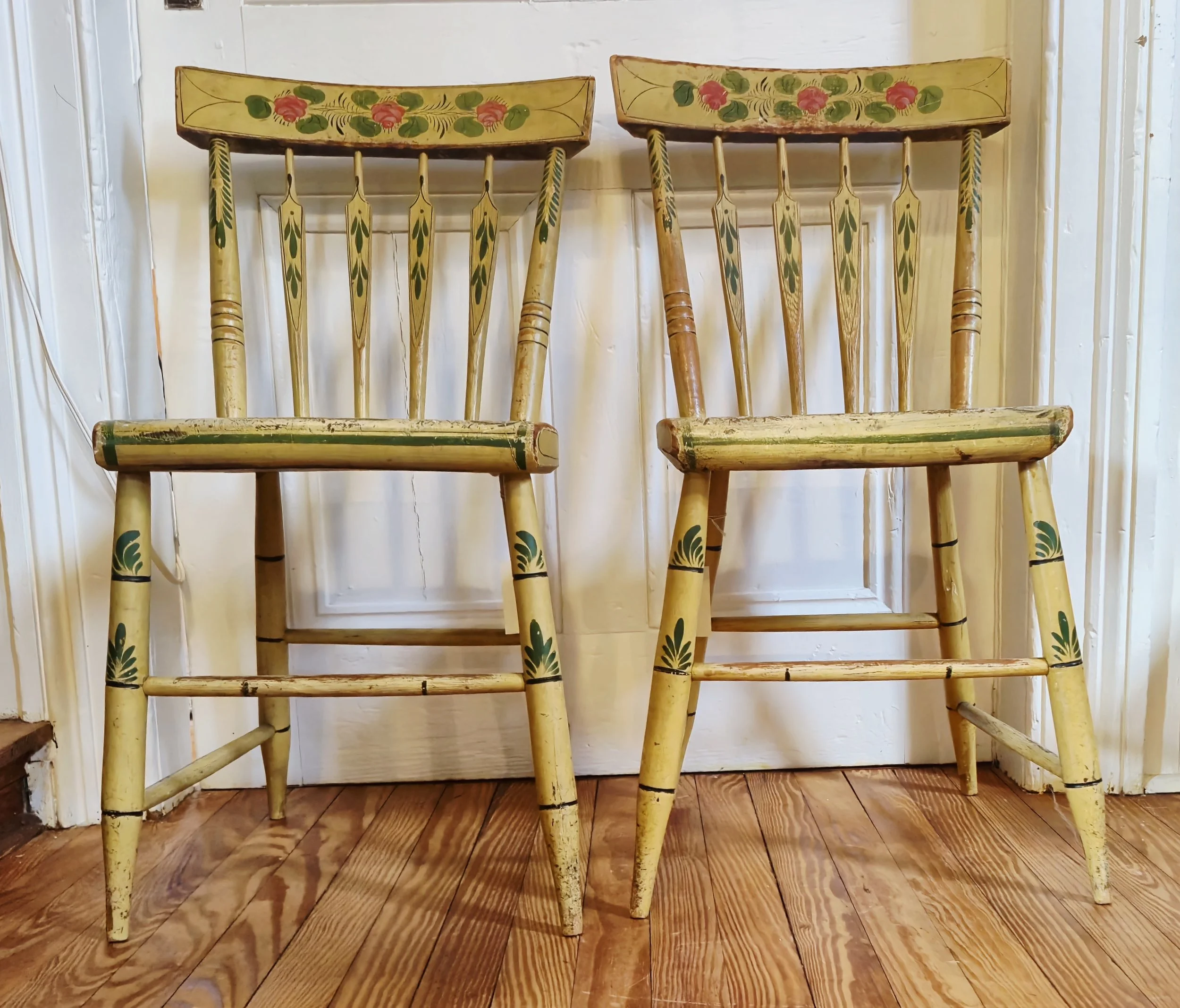
Two Hitchcock Chairs, 1818
Solid plank, saddle-set, arrow-back chairs with the original mustard paint and stenciling, probably dating to around 1818 to 1820. The Hitchcock Chair Company opened in 1818 in Riverton, CT along the Farmington River. By the late 1820s until 1843, they were making about 15,000 chairs a year. A great percentage of these chairs have been lost over time.
Support Our Work
Your donation supports the preservation of our collection, the maintenance of the historic Schoolhouse Museum, and the educational programs that bring Ridgewood's story to life for generations to come.